|
Music to enchant you:
"Since music is a language with some meaning at least for the immense majority of mankind, although only a tiny minority of people are capable of formulating a meaning in it, and since it is the only language with the contradictory attributes of being at once intelligible and untranslatable, the musical creator is a being comparable to the gods, and music itself the supreme mystery of the science of man, a mystery that all the various disciplines come up against and which holds the key to their progress."
Music to enchant you....
classicnepali songscicwak
modern nepali trackscicwak
nepali instrumental songscicwak
nepali movie sound trackscicwak
nepali folk songscicwak
nepali bhajanscicwak
everyones favourite listen hit nepali,hindi and english songscicwak
nepali radio hitscicwak
nepali hit expresscicwak
"It is the stretched soul that makes music, and souls are stretched by the pull of opposites—opposite bents, tastes, yearnings, loyalties. Where there is no polarity—where energies flow smoothly in one direction—there will be much doing but no music."
songs:
1.song yosanjh.cicwak
2.song kya bore.cicwak
3.song mero sansar.cicwak
4.song pida.cicwak
5.song rataima.cicwak
6.song jauna.cicwak
7.song smriti kaa.cicwak
8.song andhyaroma.cicwak
9.song zindagicicwak
10.song goretoo cicwak
11.song china company.cicwak
12.song sangai sangai.cicwak
13.song romance.cicwak
14.song mutu bitra.cicwak
15.song biteka kura.cicwak
16.song timra nayan.cicwak
17.song ekadashi bazaarma.cicwak
18.song zindagi ko key barosa.cicwak
19.song meri sapani.cicwak
20.song musu musu.cicwak
21.song mathi mathi sailungayme .cicwak
22.song timi bina.cicwak
23.song sayad.cicwak
24.song tyo raat ko samjana .cicwak
25.song hindi bahoome remix.cicwak
26.song musu msu remix hindi.cicwak
27.song country roads.cicwak
28.song tears in heaven.cicwak
29.song mutu bhitra.cicwak
30.song hunne hunee .cicwak
"Music is your own experience, your own thoughts, your wisdom. If you don't live it, it won't come out of your horn. They teach you there's a boundary line to music. But, man, there's no boundary line to art."
"Great music is that which penetrates the ear with facility and leaves the memory with difficulty. Magical music never leaves the memory."
"It is cruel, you know, that music should be so beautiful. It has the beauty of loneliness & of pain: of strength & freedom. The beauty of disappointment & never-satisfied love. The cruel beauty of nature, & everlasting beauty of monotony."
"Music, in performance, is a type of sculpture. The air in the performance is sculpted into something."
|
|
|
Ten Ox-herding Pictureswith the Verses Composed by KAKUAN Zenji:
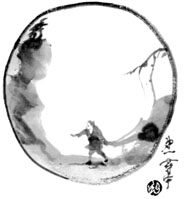
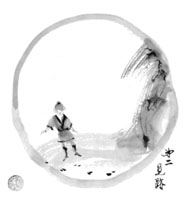
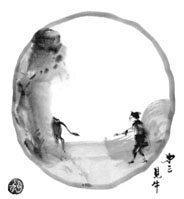
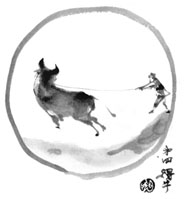
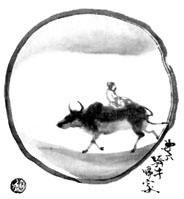
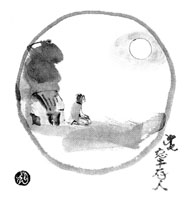
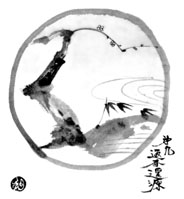
The "Ten Ox-herding Pictures" are one example of "Ox-herding Pictures." Here, our essential self is compared to an ox. We seek the ox, grasp it, tame it and finally the self which has always been seeking becomes completely one with the ox. But this also is forgotten so that we now simply carry on our ordinary lives. This is the process described by the Pictures. They show concretely the progression of our practice and are very helpful for a self-examination of our own practice and as encouragement for further practice. I hope then that studying the Ten Ox-herding Pictures will provide an opportunity for all of us to continually examine our practice and also give an indication for self-reflection as to what stage we have now arrived.
|
|
|
Ten Ox-herding Pictureswith the Verses Composed by KAKUAN Zenji:
All that is known about the author of the verses to the Ten Ox-herding Pictures, Master KAKUAN Shion, is that he was a disciple of DAIZUI Genjô [1065-1135], the twelfth in the line of Master Rinzai. His dates of birth and death as well as other information are unclear. To each of the ten pictures of the Ten Ox-herding Pictures Master Kakuan has first put a verse and at the end his disciple, Jion (some say Kakuan himself, others say the friend of Kakuan) is said to have put a general introduction and a brief introduction to each one of the verses.
|
|
|
Ten Ox-herding Pictureswith the Verses Composed by KAKUAN Zenji:
In the Ten Ox-herding Pictures a little child and an ox are depicted. The ox is the essential self which we are seeking. The little child represents the self of the phenomenal world which wants very much to grasp the essential self - not through concepts and thoughts, but as it really is. This little child (the self of the phenomenal world) is, in fact, always seeking something. It wants money, status, and fame. But life is more than just money, more than just status, and more than just fame. So, the self goes on seeking, now through this philosophy, now through that religion, and endeavors to grow and to make as much progress as possible. There are some who are defeated by the struggle, become neurotic, and even go so far as suicide. For them the spirit of seeking something has operated only as a minus factor; the fact that they are still expending energy and continuing to seek something has not changed.
|
|
|
Ten Ox-herding Pictureswith the Verses Composed by KAKUAN Zenji:
But why is it that men and women always seek something in this way? According to the teaching of Zen, men and women are essentially perfect and complete, in reality limitless and absolute (this is called "buddha" [hotoke] or "essential buddha-being" [honrai-jôbutsu]). Nevertheless, though being such, they appear phenomenally as imperfect, limited, relative, passing sinful beings (sometimes this is called "ordinary people" [bompu], and sometimes "living beings" [shujô]). Besides, although human being are born this way, they cannot know the essence (Buddha nature) of their own perfection and limitless absoluteness.
|
|
|
Ten Ox-herding Pictureswith the Verses Composed by KAKUAN Zenji:
The Ten Ox-herding Pictures have concretely depicted the process in which the imperfect, limited, and relative self (the little child) awakens to the perfect, unlimited, and absolute essential self (the ox), grasps it, tames it, forgets it, and completely incorporates it into the personality. But we |
|
|
Ten Ox-herding Pictureswith the Verses Composed by KAKUAN Zenji:
must stress that these pictures and verses are merely an indication of the way to practice and not an object for conceptual thought. Thus, the study of the Ten Ox-herding Pictures are very useful for those who are actually striving to make clear the true self in Zen through the actual sitting with aching legs. But for those who want only to learn the rationale of Zen I must warn that these pictures and words will be only "white elephants" of no use whatsoever.
|
|
|
Ten Ox-herding Pictureswith the Verses Composed by KAKUAN Zenji:
Accordingly for the present study I will omit an explanation of the general introduction and proceed to explain the spirit of the particular introduction for each stage. After that I would like to appreciate each line of the verses composed by Master Kakuan himself.
Stage 1 SEEKING THE OX ,Stage 2: FINDING THE TRACKS Stage 3: CATCHING SIGHT OF THE OX Stage 4: SEIZING THE OX Stage 5: TAMING THE OX Stage 6: RIDING THE OX HOME Stage 7: OX FORGOTTEN, PERSON REMAINING Stage 8: PERSON AND OX BOTH FORGOTTEN Stage 9:RETURNING TO THE SOURCE
|
|
|